
Programmatic Advertising: The Future of Digital Advertising
What's Inside Our Programmatic Advertising Guide?
A New Era in Digital Advertising: The Power of Data and Automation
Digital ad budget management has evolved into a complex engineering discipline. This guide breaks down the programmatic advertising ecosystem, its mechanics, and its strategic value for businesses — stripped of technical jargon and grounded in a real operational perspective.
What Is Programmatic Advertising? In Plain Language
To move past the architecture and use a simple analogy: programmatic advertising works like an automated "stock exchange" for digital ad space and audience data, where inventory is bought and sold in milliseconds. The era of marketing teams manually chasing individual publishers — phone negotiations, weeks-long email chains, fixed rate sheets — is behind us. Programmatic platforms use algorithms to automatically identify the optimal ad placement, the right audience segment, and the most efficient price across the web based on defined budget and targeting parameters.
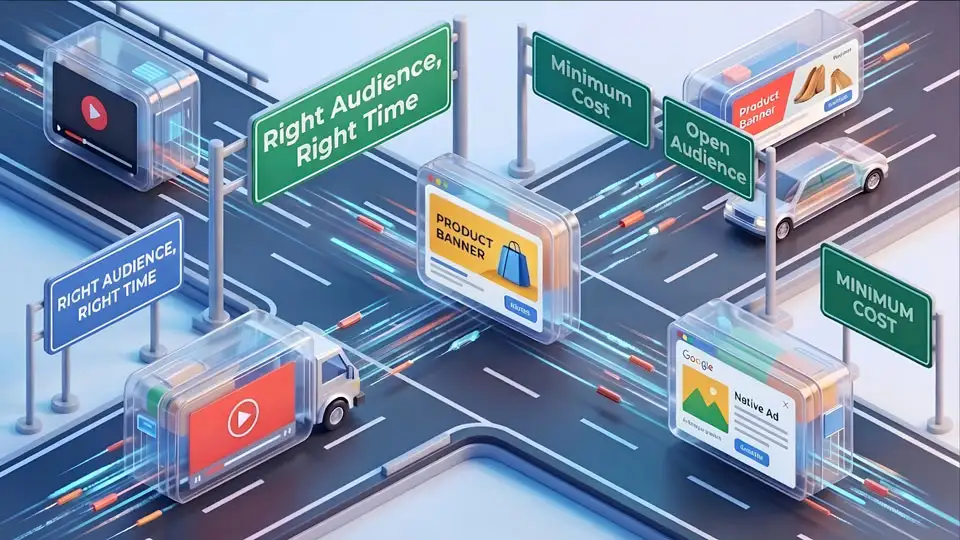
Its most critical distinction from SEM or social advertising is not being confined to a single platform ecosystem like Google or Meta. Instead, programmatic systems unify millions of independent websites, mobile applications, Connected TV (CTV) streams, and Digital Out-of-Home (DOOH) inventory into a single, cohesive management layer. The operational objective remains constant: delivering the right message to the right audience segment, at precisely the right data signal moment, for the optimal cost.
Global programmatic ad spend reached an estimated 595 billion U.S. dollars in 2024, with spending projected to approach 800 billion by 2028, making it the defining infrastructure of modern digital media.
The Structural Shift: Traditional vs. Programmatic Buying
The table below compares the programmatic model against legacy media buying across five key operational dimensions.
| Evaluation Metric | Traditional Media Buying | Programmatic Advertising |
|---|---|---|
| Transaction Speed | Days or weeks spent on manual contracts, approvals, and insertion orders | Fully automated auctions completed in milliseconds (Real-Time) |
| Targeting Precision | Broad, macro-level buying based on surface-level publisher audience estimates | Segment-based micro-targeting using first- and third-party data signals |
| Budget Efficiency | Rigid, fixed pricing with high risk of budget dilution on non-intent users | Dynamic Real-Time Bidding (RTB) that protects capital by targeting only verified segments |
| Operational Transparency | Verifying exact ad delivery environment and timing is difficult | Full real-time tracing of exact domain, time slot, and acquisition cost per impression |
| Optimization Elasticity | Modifying creatives or reallocating budget mid-campaign requires slow manual renegotiations | Dynamic allocation engines that automatically swap visuals and redistribute budget based on live performance data |
Strategic Business Advantages for Scaling Organizations
For brands with significant growth ambitions, programmatic advertising delivers these concrete operational advantages:
- Efficient Reach at Scale: Access diverse publisher, application, video, CTV, and display inventories simultaneously, rather than being constrained to a single platform ecosystem.
- Advanced Targeting Options: Target users not just by demographics but by real-time browsing behavior, purchase intent signals, and content consumption patterns through segment-based audience models.
- Real-Time Optimization: Underperforming placements or creatives are automatically eliminated by the system; budget is rerouted to the highest-converting channels without manual intervention.
- Budget Control and Granular Reporting: Every unit of spend is traceable to a specific audience segment and outcome through real-time dashboards, allowing campaign performance to be verified against concrete metrics.
How the Programmatic Advertising Ecosystem Works
Behind this automation network sit distinct software layers communicating through API integrations. Running a programmatic campaign without understanding this architecture is operationally equivalent to navigating without a map.
Core Ecosystem Platforms: DSP, SSP, DMP, and Ad Exchange
The four foundational components of the programmatic ecosystem and their respective roles are as follows:
- DSP (Demand-Side Platform — The Advertiser's Procurement Engine): The software advertisers or agencies use to build campaigns, define targeting parameters, and deploy automated bids across available global ad inventories.
- SSP (Supply-Side Platform — The Publisher's Sales Platform): The platform that allows websites, publishers, and app developers to make their available inventory accessible to the market and maximize yield.
- Ad Exchange (Digital Clearinghouse): The high-speed digital marketplace where DSP parameters (buyers) and SSP parameters (sellers) intersect to settle inventory auctions within milliseconds.
- DMP (Data Management Platform — The Data Warehouse): The central intelligence layer that aggregates, structures, and segments first-party client records, CRM data, and external intent signals — directing the DSP on which audience segments to bid for.
The Real-Time Bidding (RTB) Lifecycle Step by Step
From the moment a user accesses a URL to the millisecond an ad banner renders on screen, the entire automated transaction takes under 200 milliseconds. The sequence unfolds as follows:
- User accesses a site: A visitor lands on a website or application integrated into a programmatic network.
- SSP sends a signal: The publisher's platform bundles anonymous user data signals (location context, device type, content category) and issues an inventory sales call to the Ad Exchange.
- DSPs submit bids: Advertiser platforms evaluate the incoming audience profile against their target segments; if a match is identified, the algorithm automatically calculates value and submits a bid (RTB).
- Winner determined, ad delivered: The Ad Exchange processes all bids, identifies the highest value winner, and the selected creative asset renders seamlessly as the page loads.
Data-Driven Targeting Methods
The real power of programmatic advertising lies not in purchasing ad space itself, but in the precision with which data signals determine who receives a bid. The core targeting types are:
- Audience Targeting: Specific user clusters are targeted using demographic data, interest categories, and behavioral segment profiles.
- Contextual Targeting: Placements are selected by matching the semantic content of the host page rather than tracking individual users — an increasingly critical method as privacy constraints tighten.
- Retargeting: Users who previously visited a brand's digital properties or left a conversion funnel incomplete are re-engaged through subsequent impressions.
- Lookalike Audiences: New user segments that algorithmically mirror the data profiles of existing high-value customers are identified and targeted at scale.
Programmatic Success Strategies
Building the technology correctly is necessary, but not sufficient. Generating sustainable programmatic performance depends on several critical operational disciplines.
Brand Safety and Ad Fraud Prevention
Two persistent structural risks define the programmatic landscape: ads appearing alongside inappropriate or brand-contradicting content (Brand Safety failures) and fraudulent clicks generated by bot networks (Ad Fraud). Campaigns running without a validation infrastructure cannot detect these threats — and end up spending their budgets on algorithms rather than real audiences.
Professional agencies address this by treating dynamic whitelists, domain exclusion layers, and independent verification tools such as IAS and DoubleVerify as non-negotiable components of campaign architecture. These tools detect invalid traffic (IVT) and brand safety violations in real time, ensuring budget flows exclusively to verified, quality inventory.
Programmatic Advertising in a Cookie-less Future
Privacy-focused regulations and browser policies are progressively restricting third-party cookie usage — a shift that is fundamentally disrupting targeting models reliant on traditional user tracking. In an environment where user privacy preferences and consent-based solutions are increasingly dominant, programmatic success depends on two foundational approaches.
First, First-Party Data — audience data collected directly from a brand's own web properties and CRM systems with user consent eliminates third-party dependency entirely. Second, AI-driven Contextual Targeting — matching ad placements to the semantic content of host pages without requiring personal tracking scripts, preserving targeting precision while maintaining full privacy compliance. Poligon Interactive has prepared for this transition through server-side data architecture and first-party data integration frameworks.
Why Professional Programmatic Agency Support Is Essential
Programmatic advertising cannot be managed effectively through casual dashboard adjustments. Selecting the right DSP and DMP technologies, resolving data integrations, maintaining current audience segments, and managing campaign architecture around algorithmic learning cycles requires simultaneously advanced expertise across data analytics, software engineering, and ad technology disciplines.
Partnering with a software-literate, performance-driven organization like Poligon Interactive covers the full scope: technology selection aligned to business requirements, resolution of complex data integrations, and campaign optimization structured toward ROAS targets.